



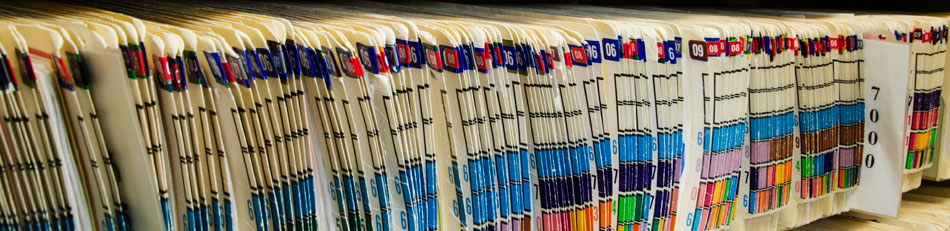

Medical Records Scanning Services for Healthcare Organizations
HIPAA-compliant scanning for paper charts, claims, microfilm, and microfiche — delivered straight into the EHR system you already use.
Your records are the backbone of patient care, but paper charts, claim files, and old microfilm slow everything down. Every minute your staff spends hunting for a file is a minute they’re not spending on patients.
We convert those records into secure, searchable digital files — and we’ve built our whole process around HIPAA. Our facilities aren’t shared with anyone else, our staff is trained in HIPAA procedures, and we continually improve our security posture and processes by completing SOC 2 Type II audits. Want the full picture of what we do? See all our scanning services.
What we scan and manage for healthcare organizations
Hospitals, clinics, and payers come to us with different records problems. Here’s how we solve each one.
Paper charts, patient records, and claims scanning
If your records room is full of paper, this is where we start. We scan backlogs of any size and can keep converting your day-forward paper too.
- Patient charts, clinical records, EOBs, CMS-1500 (formerly HCFA 1500) claims, and UB forms — converted to the digital format you choose.
- Indexing and data entry so every record is named, organized, and easy to find.
- Scan-on-demand: we store your files and scan what you need, when you need it, straight to your EHR — so you can stop paying for on-site file storage.
→ More on our document scanning services.
Microfilm and microfiche scanning
Decades of patient history often live on film that’s getting harder to read every year — and the machines that read it are disappearing. We convert it all to digital images before that becomes an emergency.
- Roll microfilm and microfiche converted to searchable digital files.
- Output delivered to your EHR, your document system, or our Digital ReeL secure hosting platform.
→ Learn about our microfilm digitization services.
Claims processing and data entry
If claims files are eating your staff’s time, we can take the scanning and keying off their plate.
- Scanning and data entry of CMS-1500 claims files.
- Extracted data formatted to match your claims application, with scheduled bulk uploads into your system.
- Quick access to claim images from inside your own system.
→ Learn more about systems integration.
Secure hosting and records management
Don’t have an IT team ready to manage millions of digital records? We’ll host them for you at our secure data center.
- Authorized users retrieve records from a web browser with keyword and full-text search.
- Document- and folder-level security, check-in/check-out tracking, read-only outputs, and redaction for sensitive information.
- Records are searchable online immediately — no on-site servers or software to maintain.
→ Find out more about Digital ReeL.
Legacy data migration
Acquiring a smaller practice means acquiring its records — and they’re usually sitting in a system your organization doesn’t use. We move patient data, images, and records out of the legacy system and into yours, so your staff works from one system instead of five.
- Records, images, and index data extracted from the legacy system and mapped to yours — so a chart that was findable in the old system is findable in the new one.
- Proof of concept first: we test the process on a small batch of your data and you approve the results before we migrate the rest.
- In-line migration for records still being added to the old system mid-project, so nothing falls through the cracks during the transition.
- Secure transfer end-to-end — encrypted drives or SFTP, never open channels.
- We’ve migrated from systems like Laserfiche, OnBase, FileNet, and OpenText ApplicationXtender — and if yours isn’t on the list, ask. Most systems are built alike.
→ Read our guide to legacy data migration.
Not sure which solution fits? Talk to a records specialist — we’ll point you the right way.
How a healthcare scanning project works
Every project follows the same four steps, so you always know where things stand.
- Assess. We review what you have — formats, volumes, condition — and what you need on the other end. This part’s free.
- Scope. You get a clear work order: what we’re converting, how it’s indexed, where it’s delivered, what it costs.
- Scan and index. Your records are converted at our secure facility under HIPAA procedures, with chain of custody tracked the whole way.
- Deliver. Finished digital records go into your EHR, your document system, or our secure hosting — your call.
What other recorders say about working with BMI
 Halifax County Public Health System, NC
“BMI Imaging Systems did a microfiche and microfilm digitization project for our agency. They demonstrated excellent knowledge during our various conversations via phone and email which made us feel confident in our company selection and purchase. The digital items received of the data presented were of very high quality, which was very impressive being that some of the data was from the very early 1900s and some were very obscure. Their team was exceptional to work with, especially Jim Detrick and Bernard Tayag! They were very precise and took pride in accurate, careful details that make the most difference. Due to their professionalism, customer service, and high-quality digitization, we will continue to use BMI as necessary for all of our imaging needs.”
— Amber Lynch, Computer Systems Administrator
New York Medical College, NY
“Excellent service! BMI converted decades of microfiche records into high-quality PDFs, saving us time and preserving our documents. Their process was very straightforward. We highly recommend their services.”
— Heather Camacho, Director of Graduate Medical Education, School of Medicine
Frequently asked questions
Is medical records scanning HIPAA compliant?
Yes. Our conversion procedures are designed around HIPAA’s requirements for paper and electronic records. Our facilities aren’t shared with other companies, access is controlled to NIST SP 800-53 standards, and our staff is trained in HIPAA processes. We’re also SOC 2 Type II audited.
Do you sign a Business Associate Agreement (BAA)?
Yes. We maintain BAAs with healthcare clients, based upon their requirements, and whose records include electronic protected health information (ePHI). We also maintain BAAs with our subcontractors.
How much does it cost to scan medical records?
It depends on volume, format, and how much indexing you need — a room of paper charts prices differently than a cabinet of microfilm. The assessment is free, and you’ll get a firm quote before anything ships. Get a free records assessment to find out what your project would cost.
Can scanned records be imported into our EHR system?
Yes. We format and deliver digital records for import into the EHR or document management system you already use, and we handle the data entry and indexing that makes the import clean.
What types of medical records can you scan?
Paper charts, patient records, EOBs, CMS-1500 (HCFA 1500) claims, UB forms, and other clinical documents — plus microfilm and microfiche. If you have a format you don’t see here, ask. We’ve probably scanned it.
What happens to our paper records after scanning?
You choose: we can return the originals to you or securely destroy them once you’ve approved the digital files. Either way, chain of custody is documented from pickup to final disposition.
How long does a medical records scanning project take?
It depends on volume, but you’ll get a timeline in your work order before the project starts. If you need certain records faster, scan-on-demand gets you priority files right away while the rest of the backlog is processed.
Can our staff access records online during and after the project?
Yes. With our hosted option, authorized users can search and retrieve records from a web browser — with full-text search, user-level security, and redaction where needed. We also provide a request system to make it easy to ask for your records while we have them in-hand.
Helpful Resources
Just getting started on your digital conversion? These are good places to learn more about scanning projects:
- BMI blogs — plain-language articles about paper scanning, microfilm conversion, secure processes, and more.
- The Digital Imaging Channel — our YouTube channel that gives you long-form videos and shorts all about digitization projects.
- Project Estimator — before talking to anyone, you can see what your project may cost with our estimator tool. Great as a starting point.
Ready to get your records out of the file room?
Tell us what you have — charts, claims, microfilm, or all three — and we’ll tell you exactly what it takes to go digital. The assessment is free and there’s no obligation.
Clients:
Trusted by healthcare organizations.