


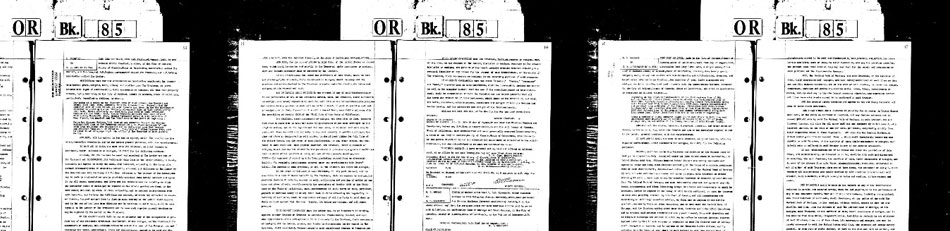

Insurance Document Scanning & Records Conversion
Title plants, policies, and claims — converted from paper and microfilm into digital files your team can actually search.
If you run records for a title, life, or health insurance company, you’re probably sitting on decades of them — lot books, geographic indexes, policies, claims — spread across paper, microfilm, and microfiche. Most of it has to be kept permanently. And most of it is a pain to search.
That’s the problem we solve. BMI converts your historic records into clean, indexed digital files — delivered into your existing system or hosted in our secure Digital ReeL application — so your team can pull any record in seconds instead of digging through film.
Who we work with
Insurance records aren’t all the same, and neither are our projects. Here’s how we help each corner of the industry.
Title insurance companies
Most title companies have inherited several plants over the years — each one built its own way, and none of them matching how you index today. The value in those old lot books, geographic books, maps, and posting records is the original context: it’s what makes an accurate search of recorded exposure possible. We digitize your plant while keeping that structure intact, so the history still works inside your current search environment.
Life insurance companies
Policies and claims with permanent retention requirements, often sitting on microfilm from decades back. We convert them into indexed, searchable digital files — and we’re built for the hard cases, like older policies with sections you can barely read.
Health insurance companies
Claims and member records come with privacy obligations on top of retention rules. We scan, index, and redact sensitive information to meet your compliance requirements, and your records stay in our secure, SOC 2 Type II audited facilities the whole time.
What we do for insurance records
Four core services. Every project is scoped to your records — not a one-size-fits-all package.
Microfilm & microfiche scanning
Legacy records on film are usually the oldest and hardest to access. We convert all of it:
- Any microform — 16/35mm roll film, 3M cartridge film, jacketed and COM microfiche, aperture cards
- Output in PDF, PDF/A, TIFF, JPG, etc.
- Adjustable grayscale processing that pulls legible images out of dark or faded film
- Or skip “traditional” conversion entirely — Digital ReeL is a practical, affordable option for film archives you rarely touch
→ Learn about our microfilm digitization services.
Paper document scanning
Back-file (the historic backlog) and day-forward (everything new that comes in):
- High-volume scanning of policies, claims, plant records, and maps
- Indexing and data entry to your exact field specs
- Poor-quality originals are a specialty — a policy you can’t read isn’t worth much, no matter how fast it loads
→ More on our document scanning services.
Secure document hosting
Skip the extra storage hardware and IT overhead — we host your records at our secure data center:
- Staff and vendor retrieval of plant records, policies, and claims from anywhere
- Plant access for other entities under rental, lease, or cooperative arrangements — with auditing
- Full-text search (OCR) across everything — run a chain-break search on any name, number, date, or address combination
- A hosted disaster copy, so a fire, flood, or data center outage doesn’t take your records with it
- Redaction of sensitive information to meet compliance requirements
→ Find out more about Digital ReeL hosting.
Data extraction & systems integration
Already have a system you like? We’ll meet it where it is:
- Digital data formatted to your custom specs for import into your existing platform
- All industry-standard formats, delivered on the media of your choice
→ Learn more about systems integration.
Not sure which of these fits your project? Tell us what you’ve got and we’ll point you in the right direction.
How a project works
- Tell us what you have. Rolls, fiche, boxes, plants — roughly how much and what format. That’s enough to start.
- We scope it and run a sample. You see real results from your actual records before you commit to anything.
- We scan and index. Your records are converted in our secure facilities with full chain of custody.
- You get a finished product. Files delivered into your system, or hosted and searchable in Digital ReeL.
What insurance clients say about working with BMI
 Pekin Life Insurance Company
“BMI’s Digital ReeL provided us with a feasible approach to converting Microfilm images as old as 1965 into easy-to-access digital images. The BMI team was extremely flexible and responsive throughout the entire project. We are now able to quickly and easily remotely access all images via a simple-to-use web-based interface, significantly improving our employee experience, operational efficiency, and turnaround time.”
— Carissa Isbell, Asst. Vice President – Claims (Life)
Frequently asked questions
How much does insurance document scanning cost?
It depends on volume, format, and how much indexing you need — a few boxes of paper is a very different project than 5,000 rolls of microfilm. Every project gets a custom quote, and we usually run a sample first so pricing reflects your actual records, not a guess.
Can you digitize old title plant records like lot books, geographic indexes, and maps?
Yes — that’s a specialty of ours. Title companies often inherit several plants, each built its own way. The value is in the original context, so we scan your plant while keeping its structure and history intact, then make it searchable in your current environment.
What if our microfilm or paper records are in bad shape?
Hard-to-read records are our thing. We use adjustable grayscale processing to pull legible images out of dark, faded, or poorly filmed originals. Legibility comes first — a record you can’t read isn’t worth much, no matter how fast it loads.
Are your facilities secure enough for insurance records?
Yes. BMI is SOC 2 Type II audited, and your records stay in our secure facilities with a documented chain of custody from pickup to delivery.
Can you redact sensitive information from policies and claims?
Yes. We redact and remove sensitive information from plant records, policies, and claims to meet your compliance requirements — built into the project workflow, not bolted on after.
Can the digital files load into our existing claims or title system?
Yes. We format the data and images to your specs and support all industry-standard formats, so the files import cleanly into the system you already use. If you’d rather not manage them at all, we can host them in Digital ReeL instead.
What happens to our paper and microfilm after scanning?
Your call. Once you’ve verified the digital files, we can return the originals to you, or arrange secure destruction.
How long does a records conversion project take?
It scales with size and complexity — smaller back-file projects wrap up much faster than multi-plant conversions. We lay out the timeline in your quote, and we can deliver in batches so you start using records before the whole project is done.
Helpful Resources
Just getting started on your digital conversion? These are good places to learn more about scanning projects:
- BMI blogs — plain-language articles about paper scanning, microfilm conversion, secure processes, and more.
- The Digital Imaging Channel — our YouTube channel that gives you long-form videos and shorts all about digitization projects.
- Project Estimator — before talking to anyone, you can see what your project may cost with our estimator tool. Great as a starting point.
Ready to make your records searchable?
Tell us about your project — format, rough volume, what you want at the end — and we’ll come back with a custom quote. No pressure, no obligation.
Clients:
Trusted by insurance companies nationwide.