


If your office has student records sitting on microfilm, you’ve probably hit the same fork in the road. Do you pay to index every student so you can pull any record by name or keep it simpler and cheaper by naming the scanned files by the roll label?
It’s one of the most common questions we get from registrars. The honest answer is that it depends on your situation, so here’s how to think it through before you spend a dollar.
First, What Are You Actually Choosing Between?
There are really two ways to go, and they sit at opposite ends of the cost scale.
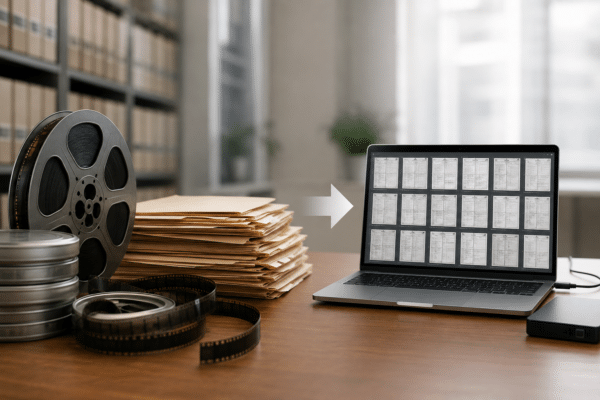
Roll level means we scan each roll of film and name the file by the roll. It recreates how you find records today but in digital form instead of on a reader.
File level (or student level) means we pull every student’s record into its own file, named by student name or ID, so you can pull any one of them up in seconds.
Roll level is the budget-friendly starting point.
File-level indexing is the premium option, and the jump in price is bigger than most people expect.
Why This Is a Case-by-Case Call
There’s no one-size answer here. It comes down to what you actually need and what you’re able to work with.
A few things tip the decision toward file-level indexing:
- You need every record named and loaded into a system, and one big file per roll won’t cut it
- You’re pulling individual student records constantly (call it multiple times a day) so fast retrieval pays for itself
- You’ve got the budget and you simply want it done all the way
The primary decision point is access. If the daily pain of pulling records lives on the physical film, going digital is what fixes that, and the indexing level just decides how fast that final step is.
If you’re only reaching for these records once in a while, roll level is almost always the way to go.
And if you’re somewhere in the middle and genuinely not sure, that uncertainty is itself a signal. Which brings us to the most common mistake we see…

The Trap: Thinking Digital Has to Be Perfect
Here’s the pattern we run into pretty often: a registrar assumes they want file-level indexing, not because they’ve run the numbers, but because digital somehow feels like it has to be perfect.
So they picture every student instantly searchable and decide that’s the standard. But when we walk them through it, most haven’t even considered starting at roll level and adding more later.
That option takes the pressure off. You don’t have to solve everything on day one. You just have to get off the microfilm!
And in our experience, the offices that start at roll level tend to be glad they did. We rarely hear back from someone wishing they’d spent more: they like what they have, and it’s already a leap past the film.

What Roll Level Actually Feels Like
The fear is that roll level means one giant, unsearchable blob. It really doesn’t.
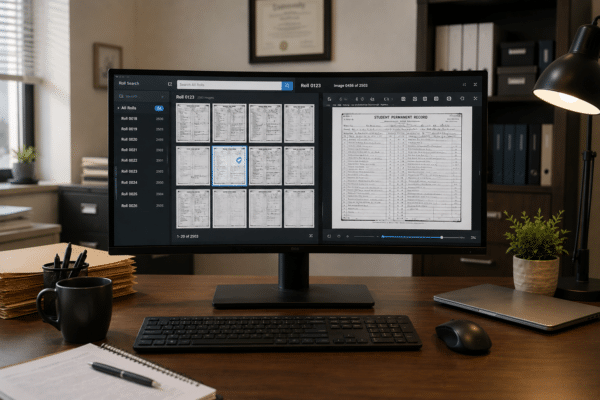
If you want PDFs, we hand you a multi-page file per roll (say a 2,500-page PDF) with OCR baked in, so you can search it by name and scan through it fast. We deliver the grayscale images as single pages in roll-level folders too, since full grayscale PDFs with OCR get unwieldy in a hurry.
If you’d rather have something more polished, Digital ReeL shows your collection like a roll of film you can actually search across — every roll at once — with tools to enhance the images.
Either way, the way we describe it is simple: it’s exactly how you find records now, except it’s inherently faster. No physical film, no reader, no walking to a machine, no maintenance.
Use the “building block approach” and set a good foundation, and improve from there.
What File-Level Costs and Why Waiting Doesn’t Cost You More
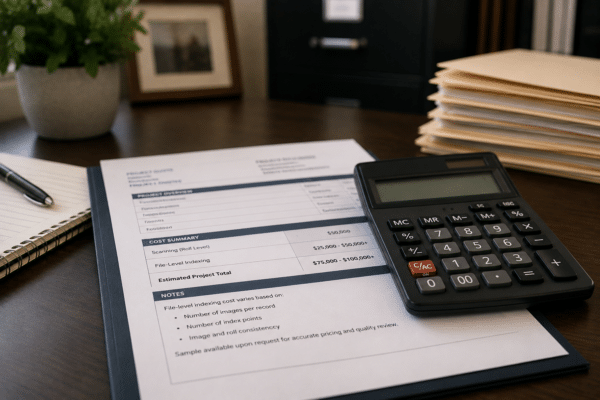
File-level indexing isn’t a small bump. As a rough rule of thumb, if scanning the film runs you $50,000, expect file-level indexing to push the project to at least $75,000 to $100,000 (and often more, depending on how the records are laid out).
The price swings on things like how many images are in each record, how many index points there are, and how consistent the images (and rolls of film) are. That’s why, if you’re serious about file-level, we can run a sample first so you see the real number and the real quality before you commit to anything.
Funny enough, that sample often makes the decision for people. Once the real file-level cost is sitting right next to the roll-level price, plenty of registrars decide roll level is more than enough.
Now the question everyone asks: if I start at roll level and index later, does it cost more? It doesn’t. Once we’ve scanned the film, the digital files already exist, so indexing later is just a separate phase added on.
We’ve done exactly that with clients: scan everything in phase one, then go back through the PDFs we already made and add file-level indexing in phase two. Starting small didn’t penalize them.
Don’t Miss the Forest for the Trees
If you take one thing from all this, let it be this:
Don’t get so locked on perfect indexing that you lose sight of the real win.
The trees are the little details: needing that one exact student’s file to pull up on command. The forest is crossing the river from analog to digital, and that’s the move that actually saves your office time, because you get roughly 90% of the value just by getting off the film.
Here’s the math we walk people through. Say you’ve got 500 rolls of student-record microfilm, which is about 1.25 million images, or roughly 250,000 students at five pages each.
How many of them will actually contact your office over the next ten years? Maybe 5%.
Spending tens of thousands to index all 250,000, when only a sliver will ever be requested, is a lot of money chasing a few records. Get them digitized, protect the original film, keep your backups, and if you decide you want file-level down the road, you can always do it then.

Next Steps
Reach out to us today! Click the “Get Your Quote” button below, fill out the form, and we’ll quickly reply to you to discuss your project.
Further Reading
What Happens to Your Records During a Scanning Project?
What happens to your records during a scanning project? This guide walks through how records are tracked, secured, and protected from pickup through final delivery.
Planning a Digitization Project Before the Next Academic Budget Cycle
Academic budgets follow strict cycles. Learn why starting your digitization planning before budget season leads to stronger proposals, smoother approvals, and better execution.
Identifying The Root Causes Of Student Transcript Request Challenges & How Digitization Addresses Them
Transcript requests are crucial in higher education, but many institutions face delays and security issues due to manual processes and disorganized systems. This blog explores the root causes of these challenges and how digitization addresses them to provide a faster and more reliable service to students and alumni.